
What the World's Healthiest-Aging Populations Can Teach Us About Living Independently
In neighborhoods across Japan, many older adults spend an afternoon or two each month at a local "salon": a volunteer-run gathering within walking distance of home, with a nominal fee, light exercise, conversation, and something to look forward to. It looks like recreation. For nearly two decades, Japanese researchers have been asking whether it is something more. [1]
That question sits at the center of healthy aging. The countries with the longest lives are not simply better at treating disease. Many of them also make it easier to keep moving, stay connected, and catch small problems before they become crises. For older adults and the families who love them, that is the more useful lesson.
Living Longer Isn't the Same as Living Well
Three ideas are worth separating.
Lifespan is how long a person lives.
Healthspan is how many of those years are lived in relatively good health. The World Health Organization measures it at the population level as healthy life expectancy (HALE): the equivalent years a person can expect to live in full health.
Functional independence is the ability to carry out meaningful daily activities, make one's own decisions, and take part in community life.
WHO's most recent comparable estimates (2021) show how far these can diverge. [2]
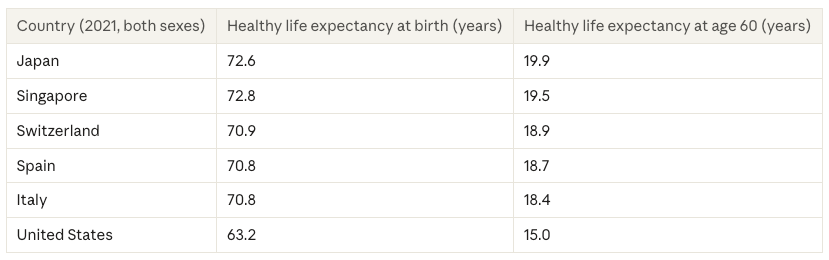
A 60-year-old in Japan can expect, on average, about five more years of healthy life than a 60-year-old in the United States. Three cautions apply. These are modeled population averages with overlapping uncertainty ranges, so the top five are best read as a group, not a ranking. 2021 was a pandemic year. And HALE is not the same as disability-free life or independent living; it weights years by health status rather than counting what a person can still do.
The point is not merely to add years. It is to protect the abilities and relationships that make those years one's own.
Lessons from Japan, Singapore, and Mediterranean Communities
Japan: participation as prevention. Japan's culture offers the idea of ikigai, a reason for being. Its public policy has given that idea a practical form. In 2015, Japan reformed its long-term care insurance law to shift prevention from targeting high-risk individuals toward community-wide efforts, modeled on the ikoino saron gathering places described above. [1]
The Japan Gerontological Evaluation Study (JAGES) has tracked what happens to people who participate. Among nearly 13,000 older adults followed for four years, those active in one, two, or three or more types of community groups had progressively lower rates of new functional disability (adjusted hazard ratios 0.83, 0.72, and 0.57). [3] Over 9.4 years, socially participating adults had lower adjusted odds of needing long-term care (0.82) and of dying (0.78). [4] These are observational associations, and the authors acknowledge that healthier people may simply participate more.
A stronger test came from the town of Taketoyo, which opened salons in 2007. Using methods designed to reduce selection bias, researchers found salon participants had roughly half the hazard of developing functional disability over five years. [5] A 2025 follow-up in the same town estimated three-year care costs about 6% lower for salon participants (roughly US$578 versus US$617 per person), though the study was small and its authors judged the savings, so far, too modest to cover the program's cost. [6] Neither study is a randomized trial, but together they suggest that social participation is more than recreation.
Singapore: organizing the pieces. Singapore reached "super-aged" status in 2026 and launched Age Well SG, a national program led jointly by its health, housing, and transport ministries, with S$3.5 billion committed over a decade. [7] More than 230 Active Aging Centers now place a center near about eight in ten seniors, offering program in social, physical, cognitive, learning, and volunteer domains. [8] A national outreach office contacts residents aged 60 and older to identify needs and connect them to services, and new public housing pairs senior-friendly apartments with care that can expand over time. [9] These initiatives are too recent to explain Singapore's long-standing longevity. Their value is the design: activity, connection, housing, and care are planned together rather than separately.
Italy and Spain: movement and meals woven into daily life. Mediterranean life is often romanticized, and not every older Italian or Spaniard enjoys close family or walkable streets. Still, the dietary pattern has measurable associations with aging well. In the U.S. Nurses' Health Study, women whose midlife diets most closely followed a Mediterranean pattern had 46% higher odds of reaching their 70s free of major chronic disease and of physical, cognitive, and mental-health impairment. [10] Again, this is observational, and the cohort was largely white female nurses.
The strongest Mediterranean evidence comes from Spain itself. In PREDIMED, a multicenter trial of 7,447 Spanish adults at high cardiovascular risk, a Mediterranean diet supplemented with extra-virgin olive oil or nuts was associated with about 30% fewer major cardiovascular events over a median of 4.8 years than a reduced-fat diet (hazard ratios 0.69 and 0.72). [17] The trial was reanalyzed and republished in 2018 after randomization problems at some sites, and it measured heart outcomes rather than independence.
The Three Foundations of Healthy Aging
Mobility is foundational to independence. One in four U.S. adults aged 65 and older reports a fall each year, and the age-adjusted fall death rate rose 21% from 2018 to 2024. [11] The encouraging news is among the strongest in geriatrics: a Cochrane review of 59 randomized trials found that exercise reduces the rate of falls by 23%, with balance and functional training carrying high-certainty evidence. [12] Strength and balance are not ends in themselves. They are what let someone walk to church, carry groceries, or say yes to an invitation.
Connection and purpose are health factors, not extras. A meta-analysis of 148 studies and more than 300,000 people found that stronger social relationships were associated with 50% higher odds of survival, an effect comparable to well-known risk factors. [13] Notably, simply whether someone lived alone was the weakest predictor; how integrated they were mattered far more. Living near family is not the same as being connected. The 2024 Lancet Commission also lists late-life social isolation among 14 modifiable risk factors that together account for an estimated 45% of dementia cases. [14]
Proactive, coordinated support helps preserve function. WHO's Integrated Care for Older People (ICOPE) guidance asks health and care workers to detect declines in intrinsic capacity (mobility, cognition, vision, hearing, mood, vitality), identify social care and support needs, and build a personalized care plan. [15] [16] It is a framework, not proof that coordination extends life. Its premise is simply that function is easier to protect than to restore.
Switzerland offers one of the more striking trials. In the canton of Solothurn, 2,284 adults aged 65 and older were randomized to usual care or two years of health-risk assessment, nurse home visits, and counseling coordinated with their primary care physicians. Eight years later, 77.9% of the intervention group were alive versus 72.8% of controls (hazard ratio 0.79). [17] It is a single trial from the early 2000s, and it could not show which elements mattered. Together, these studies suggest that structured, follow-through support can make a difference, not that any particular service guarantees one.
Why Our Traditional Approach May Be Missing Something
U.S. healthcare is often excellent at diagnosing and treating specific conditions. It is less consistent at noticing the quiet changes that come first: a shorter daily walk, a skipped bridge game, a rug that has become a hazard. Each clinician sees one slice. No one is assigned to watch the whole trajectory, connect the dots, and make sure recommendations turn into action. Families often learn about decline only after a fall or hospitalization.
Bringing These Principles Together Through Crestwell
What would it look like to bring these lessons together for older adults and their families here in the United States?
Crestwell Private Client Group was founded by a physical therapist who spent a decade in clinical practice and over a decade in healthcare leadership, and who repeatedly saw that gap. Crestwell does not replicate another country's health system, and it does not promise longer life. It draws on the same evidence-informed principles to provide personalized, ongoing independence management:
Mobility and function: comprehensive assessment of strength, balance, walking, and home safety.
Connection and purpose: planning around the relationships, roles, and activities that matter to each person.
Coordination: healthcare navigation, home-environment planning, communication with authorized family members, and regular reassessment.
Crestwell complements primary care, specialist care, skilled therapy, and emergency services; it does not replace them. Its distinguishing role is follow-through.
A hypothetical example. Margaret, 78, lives alone, sees her primary care physician regularly, and manages her own affairs. Over a year, she walks less, stops attending her book club, and grows hesitant to leave home. Nothing has gone wrong, yet. A Crestwell assessment finds slower gait speed, a dimly lit staircase, and a worry about driving after dark. With Margaret's consent, Crestwell shares findings with her physician, who refers her to outpatient physical therapy. Crestwell arranges lighting and a handrail, identifies a daytime book group and transportation, and checks back at regular intervals to see what is working. Margaret stays in charge; the plan simply keeps her options open.
Conclusion
The world's healthiest-aging populations do not share one secret. They share a pattern: movement built into ordinary days, relationships that give people a reason to show up, and systems that notice change early. Healthy aging is not only a matter of treating illness or extending lifespan. It requires intentionally supporting the abilities, relationships, environments, and coordinated resources that let people keep living full, independent lives.
Age with Purpose. Live with Independence. To learn how Crestwell approaches independence planning for older adults and their families, visit www.CrestwellPrivate.com.
References
Saito J, Haseda M, Amemiya A, Takagi D, Kondo K, Kondo N. Community-based care for healthy ageing: lessons from Japan. Bulletin of the World Health Organization. 2019. https://pmc.ncbi.nlm.nih.gov/articles/PMC6653820/
World Health Organization, Global Health Observatory. Healthy life expectancy (HALE) at birth (WHOSIS_000002) and at age 60 (WHOSIS_000007), 2021, both sexes. Accessed 12 Oct 2026. At 60 · At birth
Kanamori S, Kai Y, Aida J, Kondo K, Kawachi I, Hirai H, et al. Social participation and the prevention of functional disability in older Japanese: the JAGES cohort study. PLOS ONE. 2014;9(6):e99638. https://doi.org/10.1371/journal.pone.0099638
Takahashi S, Ojima T, Kondo K, Shimizu S, Fukuhara S, Yamamoto Y. Social participation and the combination of future needs for long-term care and mortality among older Japanese people: a prospective cohort study from the Aichi Gerontological Evaluation Study (AGES). BMJ Open. 2019;9(11):e030500. https://bmjopen.bmj.com/content/9/11/e030500
Hikichi H, Kondo N, Kondo K, Aida J, Takeda T, Kawachi I. Effect of a community intervention programme promoting social interactions on functional disability prevention for older adults: propensity score matching and instrumental variable analyses, JAGES Taketoyo study. J Epidemiol Community Health. 2015;69(9):905–910. https://doi.org/10.1136/jech-2014-205345
Hirai H, Saito M, Takeda T, Kondo K. Examination of the relationship between participation in salons aimed at care prevention through the promotion of social participation and the subsequent cost of care: a 3-year prospective follow-up study in JAGES. Archives of Gerontology and Geriatrics. 2025;129:105688. https://doi.org/10.1016/j.archger.2024.105688
Government of Singapore (Ministry of Health, Ministry of National Development, Ministry of Transport). What is Age Well SG? Updated May 2026. https://www.agewellsg.gov.sg/about
Government of Singapore. Active Ageing — Age Well SG. Updated May 2026. https://www.agewellsg.gov.sg/active-ageing/
Singapore Ministry of Health. Ageing in the community. Updated April 2026. https://www.moh.gov.sg/ageing-well/ageing-in-the-community/
Samieri C, Sun Q, Townsend MK, et al. The association between dietary patterns at midlife and health in aging: an observational study. Annals of Internal Medicine. 2013;159(9):584–591. https://doi.org/10.7326/0003-4819-159-9-201311050-00004
Centers for Disease Control and Prevention. Older Adult Falls Data. Updated 4 Sept 2026. https://www.cdc.gov/falls/data-research/index.html
Sherrington C, Fairhall NJ, Wallbank GK, et al. Exercise for preventing falls in older people living in the community. Cochrane Database of Systematic Reviews. 2019;(1):CD012424. https://www.cochrane.org/CD012424/EXERCISE_exercise-preventing-falls-older-people-living-community
Holt-Lunstad J, Smith TB, Layton JB. Social relationships and mortality risk: a meta-analytic review. PLOS Medicine. 2010;7(7):e1000316. https://doi.org/10.1371/journal.pmed.1000316
Livingston G, Huntley J, Liu KY, et al. Dementia prevention, intervention, and care: 2024 report of the Lancet standing Commission. The Lancet. 2024;404(10452):572–628. https://doi.org/10.1016/S0140-6736(24)01296-0
World Health Organization. Integrated care for older people (ICOPE): guidance for person-centred assessment and pathways in primary care, 2nd ed. 2025. https://www.who.int/publications/i/item/9789240103726
World Health Organization. Integrated care for older people: guidelines on community-level interventions to manage declines in intrinsic capacity. 2017. https://www.who.int/publications/i/item/9789241550109
Stuck AE, Moser A, Morf U, et al. Effect of health risk assessment and counselling on health behaviour and survival in older people: a pragmatic randomised trial. PLOS Medicine. 2015;12(10):e1001889. https://doi.org/10.1371/journal.pmed.1001889